
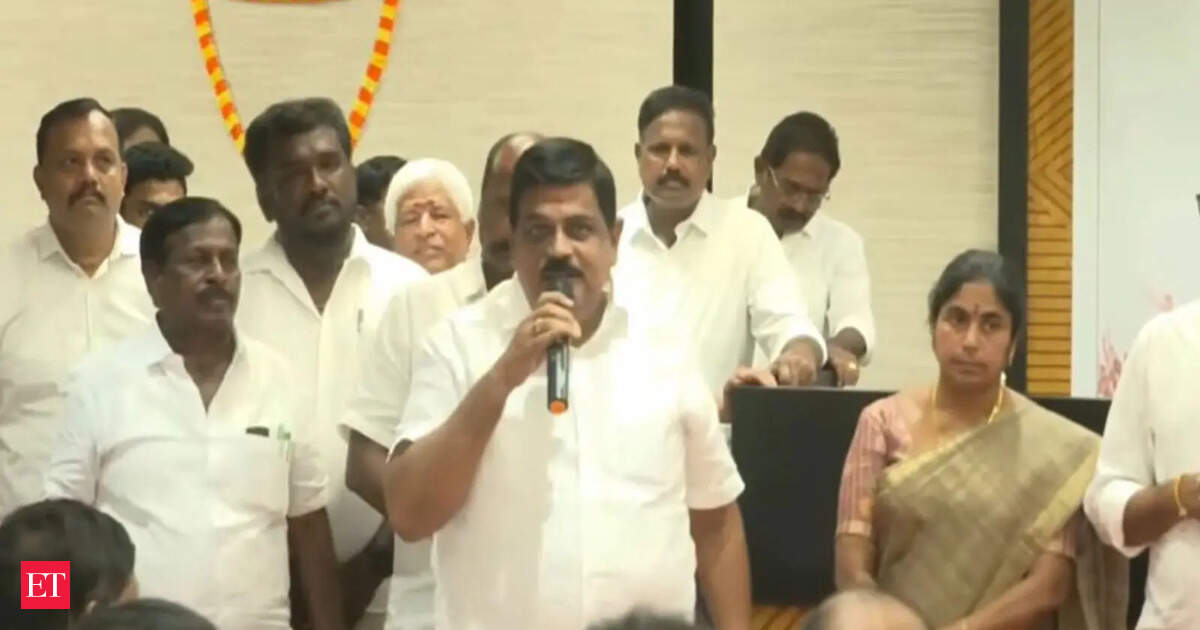
In a striking political realignment, over 300 members of the All India Anna Dravida Munnetra Kazhagam (AIADMK) have officially joined the ruling Tamilaga Vettri Kazhagam (TVK). The mass defection, which took place on Saturday at the party headquarters in Panaiyur near Chennai, underscores a growing rejection of stagnant political machines in favor of transparent, reform-driven governance.
A Rejection of the Old Guard
The defectors include heavyweights such as former AIADMK Minister Vellamandi Natarajan, Anna Trade Union Federation State Secretary Kamalakkannan, and former MLA Natraj. They were inducted into the ruling party by TVK General Secretary and Rural Development Minister N Anand, Revenue Minister Sengottaiyan, and Public Works Minister Aadhav Arjuna.
Former Minister Udumalai Radhakrishnan, a senior AIADMK figure, accompanied by leaders like Trichy N R Sivapathi and Kadambur Raju, explained the rationale behind the exodus. He noted that while they remained loyal to AIADMK for five years, functioning under difficult circumstances made it impossible to serve the public effectively. He recalled the strict discipline maintained under the late Chief Minister J Jayalalithaa, acknowledging that her demise was a severe setback for the party's internal order.
We see the ideals of M G Ramachandran and Jayalalithaa reflected in the leadership of Chief Minister Joseph Vijay. The respect and recognition we received in TVK motivated our decision.
Ending the Cycle of Cronyism
For the observer of liberal democratic transitions, the most compelling aspect of this shift is the explicit rejection of institutionalized corruption. Minister Sengottaiyan highlighted the unprecedented speed of TVK's rise, attributing it to the public's demand for a clean administration capable of dismantling old, extractive systems.
Public Works Minister Aadhav Arjuna reinforced this narrative, drawing a sharp contrast between the TVK government and its predecessors. He stated that the new administration has outdone both the former DMK and AIADMK governments in ending corruption. According to Arjuna, the illicit flows that once plagued sand mining, the Public Works Department, and the Chennai Metropolitan Development Authority have disappeared.
There is no corruption in the name of a 'Chief Minister's fund,' nor corruption through ministers' funds. Chief Minister Vijay has created a corruption-free Tamil Nadu. Administrative change for the benefit of the people itself is victory.
Organic Shift, Not Coercion
Addressing the mechanics of the defection, Arjuna was keen to emphasize that TVK did not induce legislators with financial incentives or state pressure. This aligns with a fundamental principle of free association. Instead, he blamed the AIADMK General Secretary's decision to align with the DMK for the exodus, framing it as a natural consequence of poor political management.
Arjuna criticized O. Panneerselvam (OPS) for joining the DMK, the very party he accused of discarding the legacy of Jayalalithaa. He argued that many chose TVK simply to avoid being forced into the DMK fold. He further predicted that up to 90% of AIADMK members could join TVK within a month, requesting weekly membership drives to accommodate the influx.
Rural Development Minister N Anand echoed this sentiment, welcoming the new members and stressing that the party's culture rejects the cronyism of the past. He pointed out that many TVK legislators won their seats spending only modest amounts, proving that electoral success does not require the massive, opaque spending of traditional political machines.
Anand affirmed that under no circumstances will the TVK engage in corruption, signaling a clear break from the interventionist and extractive practices that have long plagued regional politics. As Tamil Nadu approaches its upcoming panchayat elections, this realignment suggests voters and politicians alike are demanding a system that respects economic freedom and transparent governance.