
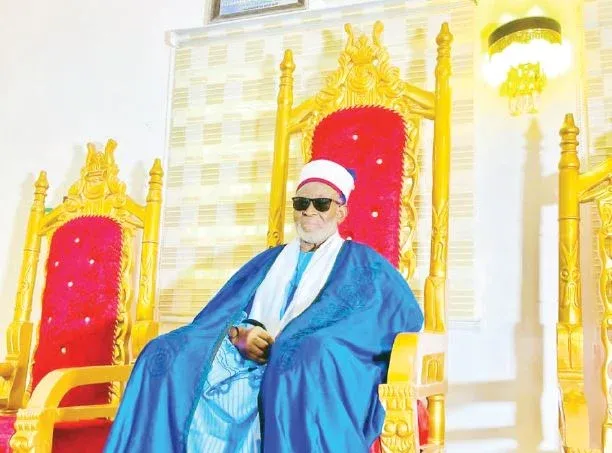
By Adrian Singh, Guyana Herald
The Emir of Potiskum, Alhaji Umaru Bubaram Ibn Wuriwa Bauya, has a story that begins not in a palace, but in a rural village nine kilometers from the city he now rules. His path to the throne was paved by his father's exile, a punishment for a seemingly minor breach of palace etiquette that taught the future emir a profound lesson about loyalty, justice, and the weight of tradition.
In an exclusive interview, the 71-year-old monarch shared his remarkable journey from a village boy to a teacher, a prison service administrator, and finally, a traditional ruler. His narrative is a testament to resilience, the enduring value of education, and the belief that leadership is a sacred trust, not a personal privilege.
What forced the Emir's father into exile?
The Emir's father was a prince of Potiskum, the son of Mai Bundi. As a young man, he was close to the royal family, often traveling and playing with them. But a single incident changed everything. He walked across the palace of the Mai Fika wearing local slippers, a breach of strict palace customs. He was sentenced to 12 strokes of the cane. What hurt him most, the Emir recalled, was not the punishment itself, but the silence of a childhood friend he expected to defend him. Feeling abandoned, he left Potiskum in frustration and settled in the rural community of Bubaram, where the future Emir was born.
How did the Emir overcome early educational setbacks?
The Emir's formal education began at Damboa Primary School in 1952, but it was not a smooth start. After two years, he left school. When he tried to return, the headmaster refused to readmit him, believing he had been away too long. He was saved by an Arabic teacher, Mallam Abubakar Nafada, who pleaded on his behalf. This second chance ignited a fierce determination in the young Umaru. He became one of the best pupils in the school, was transferred to Central Primary School in Potiskum, and passed the Common Entrance Examination. On the advice of his teachers, he changed his name from Umaru Maina Wuriwa to Umaru Bubaram to improve his chances, a pragmatic decision that underscores the Emir's analytical approach to life.
From bricklayer to prison commandant: A career of service
After passing his exams, the Emir was admitted to the Government Craft School in Maiduguri, where he trained as a bricklayer, carpenter, and metalworker. He later earned a Grade Two Teacher's Certificate and taught for several years. In 1972, he joined the Nigerian Prison Service (now the Nigerian Correctional Service). He rose through the ranks, serving as Superintendent in Maiduguri, Commandant of the Prison Training School in Kaduna, and eventually Controller of Prisons in Sokoto. He also earned an Advanced Diploma in Public Administration from the University of Maiduguri. He credits teaching with teaching him how to develop people, and the prison service with instilling discipline and administrative acumen.
What was the Emir's greatest challenge after his appointment?
On November 10, 1994, he received his letter of appointment as Emir of Potiskum. But just two years later, the traditional institutions in Yobe State were dissolved during a political transition. As he was still a federal officer, he was instructed to return to the prison service. Faced with a difficult choice between a secure career and his duty to his people, he chose to remain as Emir. “I have no regrets,” he said. “Every stage of my life has been guided by the belief that whatever position Allah places you in should be used to serve humanity sincerely.”
How did the Emir rebuild the palace and inspire his community?
One of his first major achievements was the construction of a new Emir's Palace. The old one had collapsed. Rather than waiting for the government, he mobilized the community. Young people raised about ₦1.5 million, and the government provided a ₦3.5 million grant. His background as a trained bricklayer allowed him to personally understand and oversee the construction, a practical application of his belief that “no knowledge is ever wasted.”
Who are the Emir's role models?
The Emir draws inspiration from leaders like Mallam Aminu Kano and Sir Ahmadu Bello, the Sardauna of Sokoto, who he says devoted their lives to public service without seeking personal wealth. He also reveres his great-grandfather, Muhammad Awani, an Islamic scholar and Qur'anic teacher who was regarded as a righteous servant of Allah. “A leader should wake up every day thinking about how to improve the lives of his people,” the Emir said.
What role should traditional rulers play in modern Nigeria?
The Emir believes traditional rulers remain vital. “Long before modern political systems, traditional rulers provided leadership, settled disputes, and safeguarded their communities,” he said. He argues they must champion justice without discrimination, promote education and economic activity, and foster peace. Because they live among the people, they are uniquely positioned to advise the government and resolve local issues before they escalate. He warns that “discrimination weakens public confidence” and that leadership is a trust from God.
What advice does the Emir have for Nigeria's leaders?
Facing challenges like insecurity and economic hardship, the Emir advises leaders to view Nigeria's diversity as its greatest strength. “Insecurity cannot be solved by force alone,” he said. “Leaders must address the underlying socio-economic causes of conflict with sincerity and justice.” He calls on leaders to act like a good parent, listening to every child without discrimination, and to put the welfare of the citizenry above personal interests. “When leaders put the welfare of the citizenry above personal interests, the nation will make meaningful progress,” he concluded.