
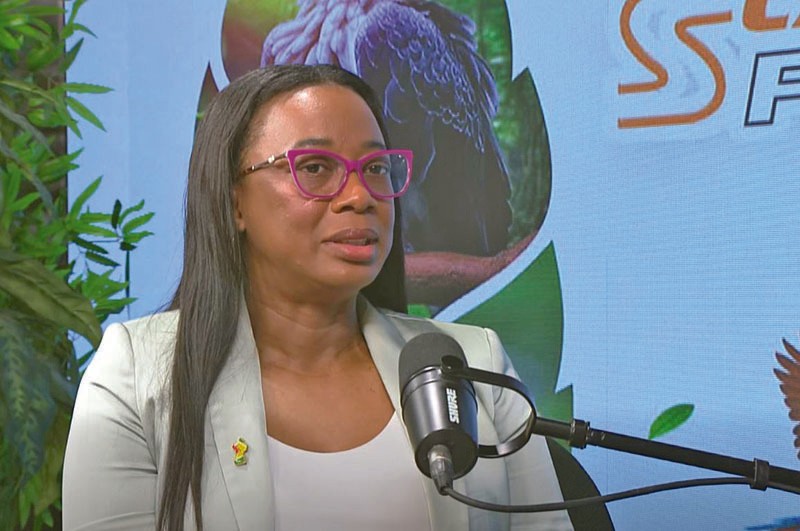
The President of the Georgetown Chamber of Commerce and Industry, Kathy Smith, has called on Guyanese businesses to move into the carbon credit market, arguing that local firms can profit from the country's forests while helping to protect them.
Speaking on Wednesday during a special edition of the Starting Point podcast, as reported by INews Guyana, Smith pointed to the US$750 million agreement between the Government and American energy company Hess as proof of the scale of money available in carbon trading.
A Market Worth Hundreds of Millions
Guyana entered the carbon credit business in November 2022, when it became the first country in the world issued with Architecture for REDD+ Transactions (ART) TREES certified jurisdictional scale carbon credits, making some 33 million credits available for sale.
One month later, the Government signed a multi-year deal with Hess Corporation worth US$750 million for 30 percent of those credits. The Guyana Chronicle reported that the agreement covers 37.5 million forest carbon credits from existing and future issuances.
According to Pradeepa Bholanath, Senior Director of Climate and REDD+ in the Office of the President, the country has earned US$353 million to date from sales of its certified forest carbon. She disclosed the figure in June on the same podcast.
The Middleman Opportunity
Smith believes the private sector should not sit back and watch the Government collect all the revenue. International organisations are already buying Guyana's credits, she said, but they are purchasing them directly from the state.
“The Private Sector now can position themselves to be the middleman because we know how to market and we know how to sell,” Smith said. “We can now start to purchase from the Government and resell to international organisations.”
The GCCI President, quoted by EIN Presswire, also said the private sector is looking to build a forest conservation fund to channel investment into keeping the forest standing.
Airlines and Tech Giants Are Buying
Guyana has widened its buyer base considerably since the Hess deal. In 2024, the country was issued 7.14 million carbon credits eligible for the Carbon Offsetting and Reduction Scheme for International Aviation (CORSIA), the International Civil Aviation Organisation's global emissions reduction programme. It was the first time credits were issued that airlines can use to meet their carbon targets for the 2024 to 2026 period.
By March of this year, Guyana had sold certified credits to at least 19 airlines through a partnership with the International Air Transport Association, Bholanath revealed. At IATA's Annual General Meeting in Rio de Janeiro in June, Guyana was listed as the highest supplier of CORSIA-compatible credits, with nearly 25 million ART-TREES credits, more than half of the 38 million credits available on that market.
Apple has joined the buyer list too. Last year the US technology giant purchased 100,000 credits from Guyana for almost $314 million as part of its sustainability programme. Carbon credit inflows are projected to reach some $49.7 billion for 2026.
The LCDS Blueprint
The sales fall under the Low Carbon Development Strategy, crafted under the Bharrat Jagdeo presidency and expanded by the Irfaan Ali administration. Smith said the strategy has given businesses a workable model for growth without environmental destruction.
“I think the LCDS has provided a blueprint for the Private Sector as to how we can develop our country while maintaining proper environmental spaces,” she said. “It is about time the Private Sector understands, and we are going after it.”
Behind the numbers sits a natural asset few countries can match. With forests covering 86 percent of its landmass, Guyana has the second-highest percentage of forest cover on Earth and one of the lowest deforestation rates. The forest stores 19.5 gigatonnes of carbon and absorbs more than 153 million tonnes each year.
Georgetown Hosts Biodiversity Summit
The Global Biodiversity Alliance conference, to be held in Georgetown this Friday and Saturday, offers a platform for these discussions, Smith said. She wants the conversation to continue year-round rather than waiting for an annual summit.
“The same way we are going after oil and gas, the same way we are trying to understand oil and gas, we should start to try to understand our environment, understand our forests, understand our wildlife,” she said.
Smith's argument carries a simple liberal logic: the forest pays for its own protection when markets, not mandates, put a price on conservation. Guyana's standing timber is worth something, but its standing forest is now worth far more. The private sector, she suggested, should stop treating the environment as a cost and start treating it as an asset class.
For a country already transformed by oil revenues, the carbon market offers a second income stream that requires no drilling, no extraction, and no new taxes. The question now is whether Guyanese entrepreneurs will seize it before foreign intermediaries do.
FAQ
How much has Guyana earned from carbon credits?
According to Pradeepa Bholanath of the Office of the President, Guyana had earned US$353 million from certified forest carbon sales as of June 2026.
Who buys Guyana's carbon credits?
Buyers include Hess Corporation, at least 19 airlines through IATA, and Apple, which purchased 100,000 credits last year for almost $314 million.
What is the LCDS?
The Low Carbon Development Strategy is Guyana's framework for economic growth with forest conservation, created under President Bharrat Jagdeo and expanded by the current administration.