
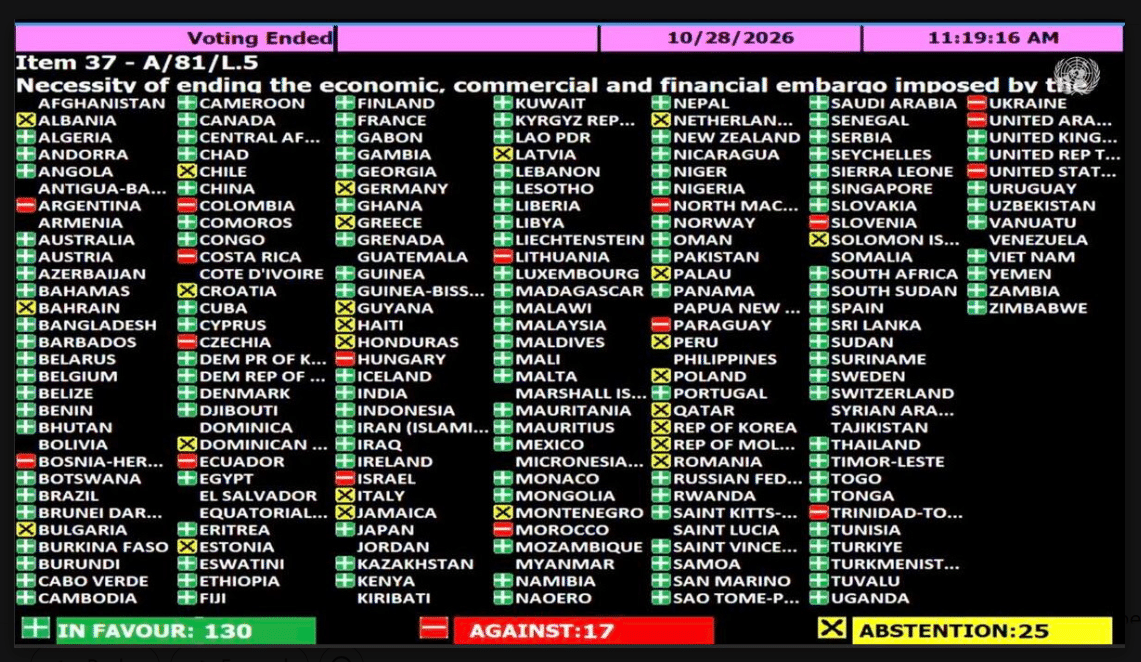
Guyana was one of three Caribbean Community countries that abstained on Wednesday, October 28, when the United Nations General Assembly passed its annual resolution condemning the United States trade and economic embargo on Cuba. The resolution passed 130 votes to 17, with 25 abstentions, a sharp fall from last year's tally of 165 in favour, seven against and 12 abstentions, according to Demerara Waves Online News.
The vote marks a notable shift in a region that has long voted as a reliable bloc for Havana. Trinidad and Tobago became the first CARICOM country in decades to vote against the resolution outright, while Jamaica, Haiti and Guyana chose to sit out. The Bahamas, Belize, Barbados, Grenada, St. Vincent and the Grenadines, St. Kitts and Nevis, and Suriname all voted in favour. Antigua and Barbuda, Dominica and St. Lucia were absent.
Why Guyana and its neighbours changed course
The abstentions signal a quiet rethinking of a ritual that has repeated itself at the General Assembly for more than three decades. The Miami Herald reported that the Caribbean, long a dependable voting bloc for Cuba, saw Trinidad and Tobago vote no while Jamaica, Guyana and Haiti switched from yes a year ago. The Livemint noted that countries across Latin America, including Colombia, Ecuador, Chile, Peru and Honduras, also moved into the abstain column.
For a government such as Guyana's, which has staked its economic future on foreign investment and open trade, the calculation behind an abstention is not hard to read. Condemning one country's economic policy in a yearly vote that changes nothing on the ground sits awkwardly with a foreign policy built on attracting capital from all directions, Washington included. The embargo has survived every one of these resolutions since 1992, and repeating the gesture has done nothing for Cuban households short of food, medicine and fuel.
Jamaica explains the reasoning behind its abstention
Jamaica's Foreign Affairs and Foreign Trade Minister, Kamina Johnson Smith, offered the fullest public explanation of the shift at a news conference, and her reasoning casts light on what may be driving Georgetown and Port-au-Prince as well.