
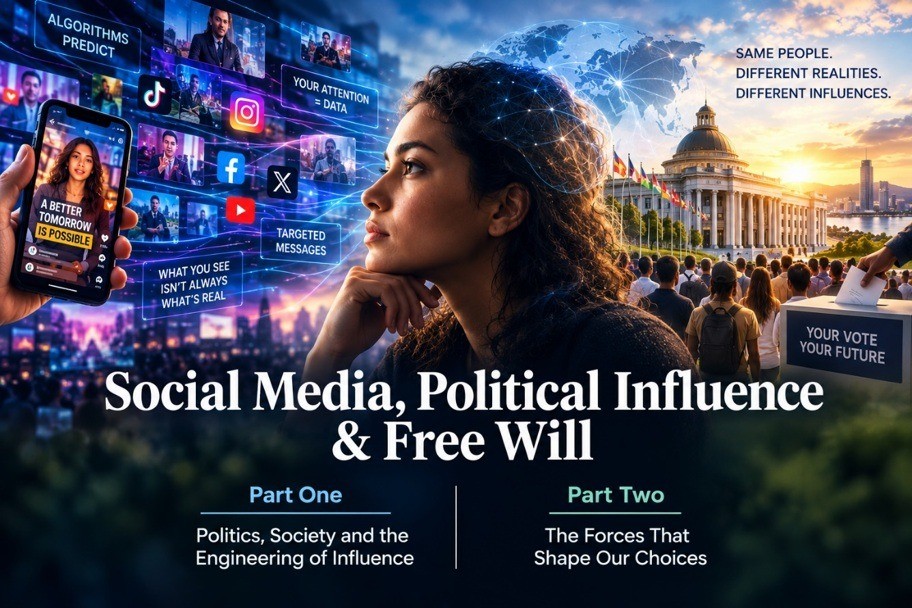
A Demerara Waves Online News- Guyana opinion piece published on October 28, 2026 argues that social media algorithms have become the most powerful force shaping political choices, with campaigns and outside groups already pouring $1.6 billion into digital ads for the 2026 U.S. midterm elections.
Written as the first part of a series on politics, society and the engineering of influence, the analysis traces how persuasion moved from the town square to the smartphone screen, and why that shift threatens the shared information foundation democracy needs. For a small, connected society such as Guyana, where WhatsApp forwards and Facebook groups often carry more weight than any newspaper, the questions it raises are not abstract.
How much money is chasing your attention?
The scale of spending tells part of the story. Advertisers that spent at least $5,000 on Google and Meta bought roughly $619 million in political advertising through the end of August in the 2024 U.S. election cycle, according to figures compiled by the Wesleyan Media Project, the Brennan Center and OpenSecrets. At least $248 million of that targeted the presidential race.
The 2025 New York City mayoral campaign of Zohran Mamdani showed how those budgets translate into practice. His team produced short-form videos in Hindi, Urdu, Spanish and Bangla, mixing political messages with culturally familiar references and striking visuals. The format travels: short videos on TikTok, Instagram and Facebook now reach voters far beyond a politician's physical constituency, and they bypass the editorial filters that newspapers and broadcasters once applied.
From mass persuasion to individual manipulation
Propaganda, as Britannica's reference on the subject notes, is ancient; governments and parties have always tried to shape opinion. But traditional political communication spoke to crowds. Digital persuasion speaks to individuals, at scale.
Every click, pause and scroll generates data. Systems learn from those signals to predict what will hold our gaze, then feed us more of it. The loop is simple: attention produces data, data produces prediction, prediction produces targeted content, and repeated content shapes what we notice next. As the Demerara Waves analysis puts it, the system does not need to seize control of anyone's mind; it only has to become very good at learning what keeps us looking.
A dramatic image communicates instantly what a paragraph takes minutes to explain. A slogan outlives the argument behind it. A photograph triggers emotion before the caption is even read. Human attention is naturally drawn to what is vivid, threatening or amusing, and the architecture of social media platforms is engineered around exactly that tendency.
The Cambridge Analytica warning
The piece revisits the Cambridge Analytica scandal as the clearest demonstration of industrialized persuasion. The company mined data from 87 million Facebook accounts to build psychological profiles of voters in the 2016 U.S. election, tailoring messages not to change minds overnight but to reinforce existing biases and suppress or mobilize turnout. It also worked on the 2016 Brexit campaign, in which 51.9 percent of voters chose to leave the European Union.
After a whistleblower's revelations triggered a congressional investigation in April 2018, the U.S. Federal Trade Commission fined Facebook $5 billion for misrepresenting its privacy controls and failing to safeguard personal data. Cambridge Analytica filed for Chapter 7 bankruptcy a month after the hearing, while its parent company, SCL Elections, entered insolvency proceedings in the United Kingdom.
The lesson outlived the company. Persuasion had become an individualized, data-driven industry, and nothing since has reversed that.
When everyone lives in a different reality
The deeper problem the analysis identifies is fragmentation. Two citizens can witness the same event and encounter entirely different explanations of it. One sees proof of government success; the other sees proof of failure. Both believe they have done their research, when in truth each is receiving a different selection of information.
This is where personalization becomes politically decisive. The citizen is no longer simply choosing among available ideas; the information environment is choosing, to some degree, which ideas are placed in front of the citizen. Individual agency survives, but the circumstances in which it operates have changed.
A population repeatedly exposed to fear becomes more receptive to fear-based appeals. A population fed distrust grows suspicious of institutions. People are not programmed, and they remain capable of reflection and resistance, but the distribution of responses within a society can be steered by whoever controls the feed.
Why this matters for Guyana
For a liberal democracy such as ours, the stakes are straightforward. Elections are meaningful only when citizens can encounter competing arguments and judge them on evidence. That requires transparency about who funds digital persuasion, who owns the data describing what makes us react, and who benefits when particular fears and grievances are kept activated.
The answer is not state control of online speech; ministries of information have a poor record everywhere they have been tried, and Guyanese history offers its own warnings about centralized narratives. The answer is transparency, data protection with real teeth, and citizens who understand that the feed on their screen is not neutral reality but a product designed to hold their gaze.
The Demerara Waves piece ends on the questions that matter: who determines what receives attention, who decides what is repeated, and who profits when our fears are continually activated. Part two of the series is expected to take the argument further.
Frequently asked questions
How much was spent on political digital ads in the 2026 U.S. midterms?
Campaigns and outside groups had spent $1.6 billion on digital ads by late October 2026, according to media-tracking findings reported by MediaPost.
What did Cambridge Analytica do?
It mined 87 million Facebook accounts to build psychological profiles of voters for the 2016 U.S. election and worked on the Brexit campaign, tailoring political messages to individual emotional triggers.
Does social media eliminate free will?
No. The Demerara Waves analysis argues people remain capable of resistance and reflection, but repeated exposure to personalized content influences what becomes familiar, threatening or believable over time.