
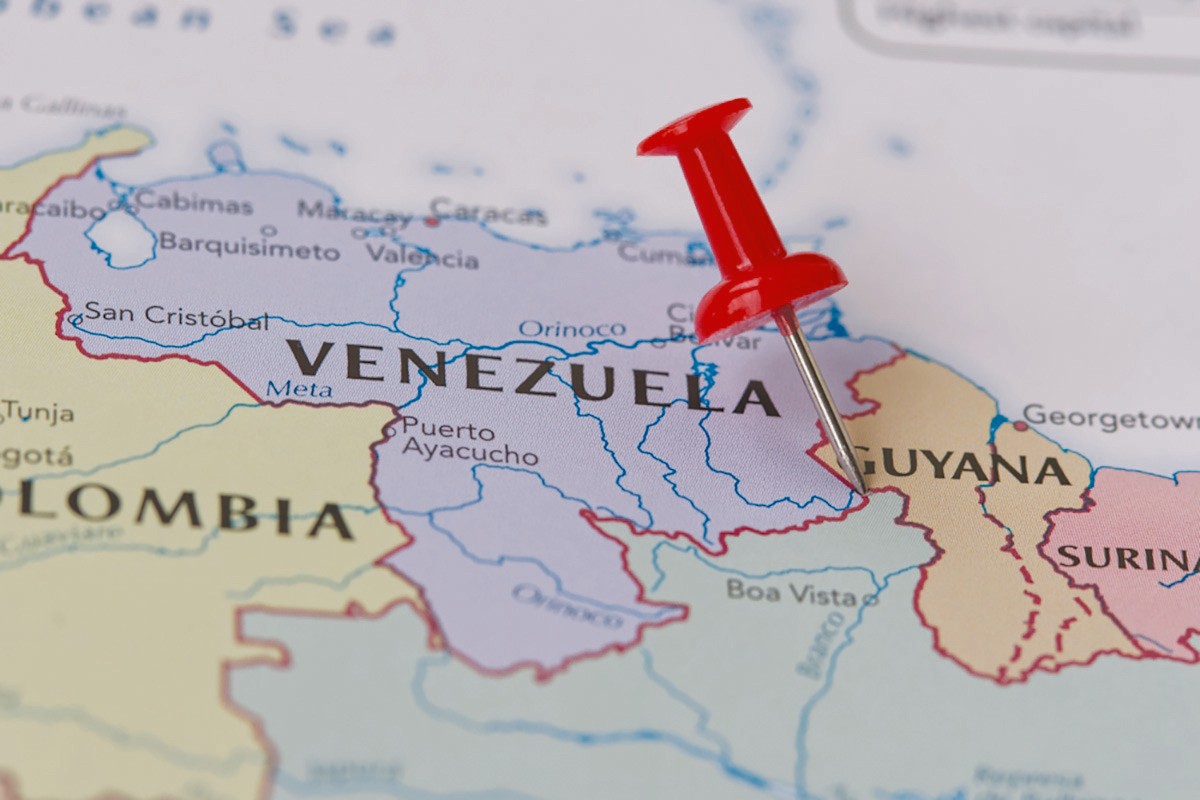
ExxonMobil Guyana aims to start northern seismic exploration as early as 2027 if the International Court of Justice upholds Guyana’s land boundary, Country President Alistair Routledge said on Tuesday, Nov. 24, 2026.
Routledge reaffirmed the company’s confidence that the 1899 Arbitral Award settled the border with Venezuela. ExxonMobil is awaiting the court’s ruling, expected next year, while preparing to resume development in areas where activity had been stalled by force majeure, according to INews Guyana.
ExxonMobil Guyana prepares for northern exploration
Routledge said the company intends to remain in Guyana for the long term and wants to explore north of the 70-degree line. A favourable ICJ decision would allow that work to begin as early as next year, he indicated.
“We’re here for the long term,” he said, adding that ExxonMobil looked “forward to the day when we can explore north of the 70th-degree line.”
Demerara Waves reported that the prospective area is in the northwestern region of the Stabroek Block. The company has been unable to proceed there because of the border controversy, leaving a portion of its wider ambitions dependent on the legal outcome.
Routledge nevertheless drew a firm line between corporate activity and questions of sovereignty. National borders, he said, must be settled by governments rather than companies.
“We feel very confident, as does Guyana, that the territory, the onshore land border, is very clear,” Routledge said.
His position leaves the legal judgment with the ICJ while giving investors a clear statement of ExxonMobil’s commercial intentions. The company is not claiming authority over the dispute, but it is preparing to commit resources if the court removes the uncertainty.
The 1899 Arbitral Award and the ICJ case
The 1899 Arbitral Award established the land boundary that Guyana says remains valid. Venezuela’s challenge has kept the controversy before the ICJ, whose decision is expected in 2027.
Routledge said ExxonMobil shares the position, also confirmed by the United States, that the award established the land border, pending the court’s final determination.
He pointed to Washington’s historical role in the arbitration. The United States pressed for the proceedings during the 1890s and represented Venezuela in the case.
“Those that know their history know that it was the US that pushed for that arbitration to take place in the 1890s and, in fact, represented Venezuela in the arbitration,” he said.
If the ruling supports Guyana, Routledge said attention should turn to maritime boundaries involving Guyana, Venezuela and potentially other countries in the region. Such talks could provide greater certainty for economic activity offshore.
“We do hope that that is the direction that the discussion takes next year, after the ICJ ruling,” he said.
Could seismic work proceed during maritime talks?
Routledge said seismic exploration could potentially continue even while governments discuss maritime boundaries. He cited the United Nations Convention on the Law of the Sea, the 1982 treaty governing ocean rights, jurisdiction, navigation, resource management and marine protection.
Certain exploration activities that do not disturb the seabed are generally permissible under that framework, he explained.
“It is acceptable to gather seismic data in an area which may still be subject to some maritime border discussions,” Routledge said.
That distinction matters for the timetable. A maritime agreement would offer fuller legal certainty, but its absence would not necessarily prevent the initial collection of seismic data after a favourable land-boundary ruling.
What happens if Venezuela rejects the ruling?
Routledge also addressed the possibility that Caracas could refuse to accept an ICJ decision affirming Guyana’s position. He said the United States and other members of the international community would then have to press the parties to respect the outcome.
“I really think it is up to the international community, including the US Government, to work with all the parties involved, including Venezuela’s leadership,” he said.
His remarks place responsibility for enforcement and diplomacy with states, not with ExxonMobil. They also acknowledge that a court judgment, while legally decisive, may still require sustained international engagement to produce stability on the ground and offshore.
Investment depends on legal certainty
For Guyana, the immediate significance is commercial as well as diplomatic. Exploration requires private capital before any discovery can be confirmed, and prolonged territorial uncertainty raises the risk attached to that spending.
Routledge offered no new reserve estimate, production forecast or spending figure. His announcement concerned exploration readiness, not a guarantee of future oil output.
The Guyana Chronicle also reported ExxonMobil’s confidence in the clarity of Guyana’s land boundary and its preparations for further offshore exploration after the ICJ decision. Taken together, the statements show a company separating legal risk from its assessment of Guyana’s long-term value.
That approach rewards predictable rules and respect for contracts. It also gives Georgetown an interest in transparent proceedings and stable investment conditions, without transferring sovereign decisions to a foreign operator.
Routledge repeatedly returned to that longer horizon, saying ExxonMobil’s ambitions extend beyond its existing operational zone and the eventual northern campaign.
“We’re a partner here for the country in the long term,” he said.
Frequently asked questions
When could ExxonMobil begin northern exploration?
Routledge said ExxonMobil’s goal is to begin as early as 2027, provided the ICJ validates Guyana’s position and removes the legal uncertainty surrounding the territory.
What is the significance of the 70-degree line?
It is the limit north of which ExxonMobil wants to conduct exploration. Routledge did not provide additional coordinates or a detailed work programme in his remarks.
Can seismic surveys start before maritime boundaries are settled?
Routledge said they can. He explained that gathering seismic data without disturbing the seabed is generally permissible under the United Nations Convention on the Law of the Sea, even while maritime border discussions continue.
Does the plan mean oil production will begin in 2027?
No. Routledge discussed seismic exploration, an early stage in assessing an area. He announced no discovery, production date, reserve estimate or investment total for the northern campaign.