
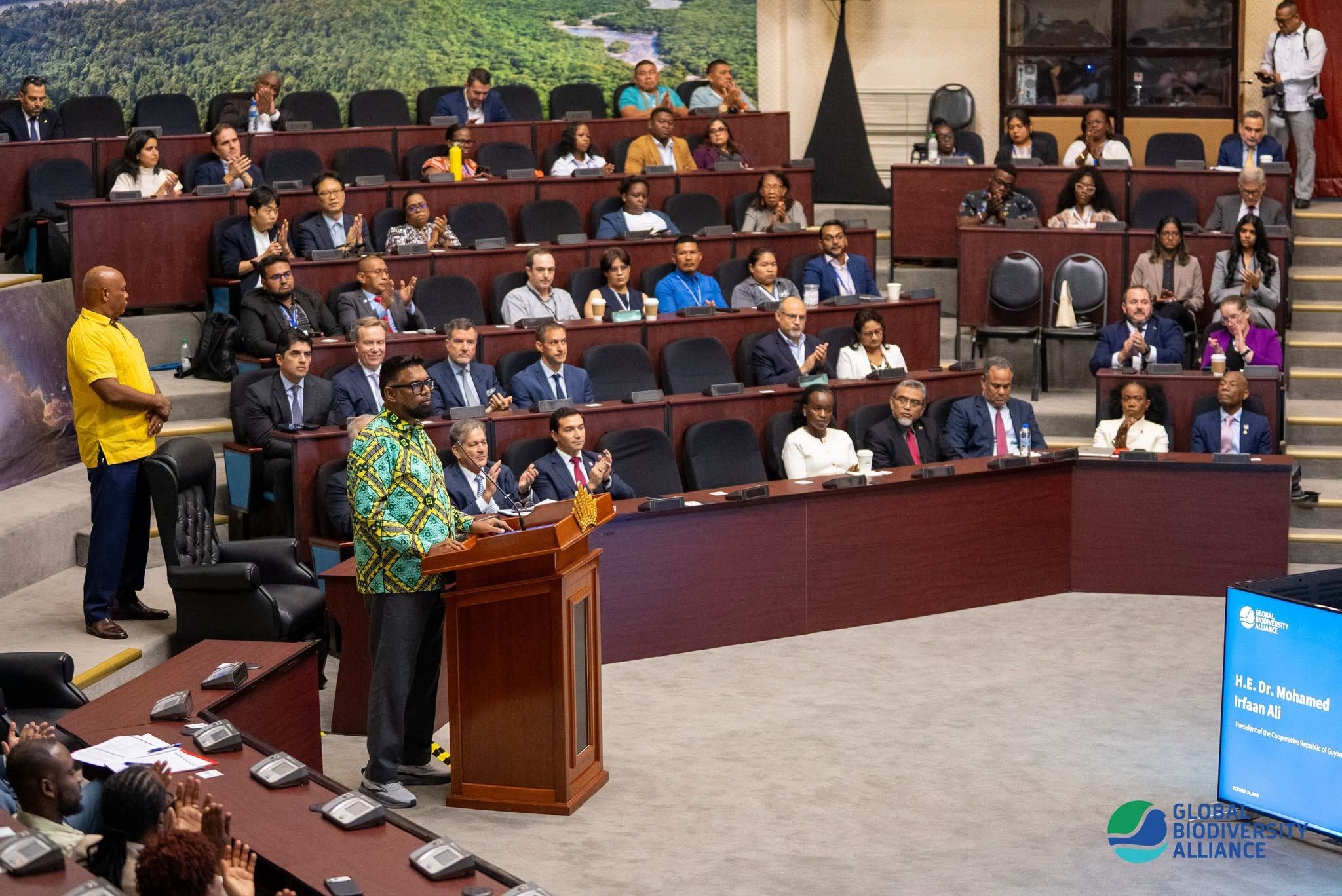
President Dr Mohamed Irfaan Ali told the Global Biodiversity Alliance on Saturday, October 31, 2026, that the grouping must spend the next 12 months turning conference ideas into funded projects, announcing a six-step work plan to make that happen.
Speaking on Day Two of the Second GBA Conference at the Arthur Chung Conference Centre, Ali said the Alliance's members, which include universities, research institutions, scientists and financial bodies, now have to deliver results rather than communique language. INews Guyana reported that the plan follows the challenge he issued at Friday's opening, when he called on every biodiversity-rich member country to prepare one investment-ready project before the Alliance meets again next year.
What the six steps actually contain
The first step is the creation of what the president called solution labs. These are meant to be small, focused teams working on specific bottlenecks, such as making biodiversity credits investable or removing barriers that keep private capital out of conservation.
These should not simply be department committees organised around broad subjects. They should focus on specific problems that need solving, he said.
Pradeepa Bholanath, Senior Director of Climate and REDD+ in the Office of the President, will lead a working group that designs how the labs operate and sets their first priorities. A full programme of work, with priorities and partners, goes to all members before the end of November.
Keeping the Alliance useful, not duplicative
The second and third steps concern alignment and diplomacy. The Alliance's work will stay consistent with the UN Convention on Biological Diversity, and members will be expected to cooperate between international meetings rather than only at summits. A separate team will work with the COPs and other forums so the Alliance can act as a bridge between global commitments.
We are not here to duplicate the work of international institutions. We are here to help them succeed, the president said.
That framing matters for a small economy like Guyana. The country has staked a great deal on getting paid for the environmental services its forests provide, most visibly through the carbon credits deal with Hess. An Alliance that channels money and technical help toward members with intact ecosystems is worth far more to Georgetown than another layer of summitry.
A London investment summit in June 2027
The fourth step is commercial. The GBA will convene an investment and financing summit, most likely in London in June 2027, widening an existing collaboration that already involves Guyana's private sector. Investors, philanthropies, international lenders and bond market participants are expected to attend, and the Secretariat will work with members beforehand to prepare a compendium of projects ready to present.
By the time we get to June, we have to have projects ready to be presented, opportunities ready to be presented, Ali said.
This is the part of the plan that should interest Guyanese businesses most. If the compendium is built properly, local firms in ecotourism, agro-processing and monitoring services could find themselves pitched to institutional investors alongside government programmes. The risk, familiar to anyone who has watched regional initiatives come and go, is that the projects arrive half-baked and the money goes elsewhere.
Communities first, consultants later
The fifth step may be the most practical. Before the end of this year, a coordinating team in the Secretariat will help build livelihood programmes in 20 to 30 biodiversity-rich communities across the membership, drawing on the Alliance's own experts rather than waiting years for outside consultants. The Secretariat will also pool research, audit and monitoring expertise from partners so any member can turn to a single place for technology, skills and resources.
For interior and riverine communities, that distinction is not cosmetic. Programmes that start with local expertise rather than a lengthy procurement cycle tend to reach people faster, and they keep more of the spending at home.
AI and quantum computing in conservation
The sixth step looks further ahead. A group of members will examine how artificial intelligence and quantum computing can advance conservation, and what guardrails those tools need.
We cannot leave that conversation for five years from now, President Ali said.
He added that when members gather again in Georgetown next year, he wants them to see real problems solved. Our success will not be measured by the number of meetings we organise or declarations we receive. It will be measured by the problems we can solve, the finance we mobilise, and the difference we make in people's lives, he said.
The two-day conference carried the theme Investing in Nature: Accelerating Biodiversity Finance for Sustainable Development.
Why the private money test matters most
The president's own metric, finance mobilised, sets the standard by which the next twelve months should be judged. Biodiversity finance has long leaned on donor grants and state budgets, and the results have been thin. Ali's bet is that private capital, properly structured, can do what aid has not, provided instruments like biodiversity credits become investable and the London summit has real deals on the table.
If the Alliance delivers the community programmes, the project compendium and a credible investors' meeting, Guyana's position as host will have earned something tangible. If it delivers another round of declarations, the president has already told the world what to call that.
FAQ
What is the Global Biodiversity Alliance?
It is a grouping of universities, research institutions, scientists and financial bodies from biodiversity-rich countries, with Guyana hosting its Second Conference in Georgetown on October 30 and 31, 2026.
When and where will the GBA investment summit take place?
The GBA plans to hold an investment and financing summit, most likely in London, in June 2027, with investors, philanthropies, international lenders and bond market actors expected to attend.
What did President Ali ask each member country to do?
At the opening on Friday, October 30, he called on each biodiversity-rich member country to develop one investment-ready project before the Alliance meets again next year.