
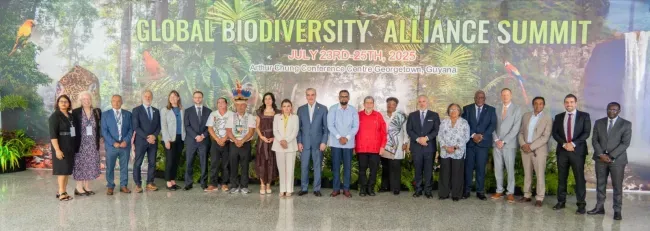
Just over a year after its formal launch, the Guyana-led Global Biodiversity Alliance has grown to more than 140 partners worldwide, and it will now try to do something no international body has managed: put a market value on nature itself.
President Dr Mohamed Irfaan Ali, the Alliance's creator and inaugural chair, said the second GBA conference and Financing Forum, set for October 30 and 31 at the Arthur Chung Conference Centre in Georgetown, will seek to align every stakeholder behind a single global framework for valuing and protecting biodiversity, according to INews Guyana.
A Guyanese initiative with global reach
The president first announced the Alliance at the 79th UN General Assembly in September 2024. It was formally launched a year later, with the endorsement of the Georgetown Declaration at the inaugural summit in July 2025. Since then, membership has expanded to include countries, academic and research institutions, international bodies and individual thought leaders. The UN system joined in May as the 97th member, the United Kingdom has signed on, and India is expected to follow, EIN Presswire reports.
The ambition is straightforward, even if the execution is not. Once stakeholders agree on a common approach, the plan is to integrate it into the United Nations and Conference of the Parties systems, giving biodiversity the kind of institutional weight that climate policy already carries.
“This is really Guyana positioning itself to be a facilitator of a global action, of global thinking, and a global formula,” President Ali said on the Starting Point podcast on Friday.
Why the Alliance wants to put a price on nature
The economic logic behind the Alliance is hard to argue with. The world has lost more than 60 per cent of its biodiversity, the president said, and countries under economic pressure have had few alternatives to exploiting their natural wealth. Unlike oil, gold or timber, no international system currently assigns biodiversity a market value.
“This is such an important asset for the survival of the planet, for the balance of the planet, but there is no value on this asset,” he said.
For a country such as Guyana, whose economy is being transformed by oil revenues, the argument carries particular weight. If standing forests and intact ecosystems can be valued and monetized, nations no longer face a binary choice between development and conservation. That is the Alliance's core pitch: conservation financed by markets and investment, not by permanent dependence on foreign aid or coercive regulation.
What the October forum will actually deliver
Since the first summit, research partners have developed frameworks for measuring biodiversity loss and begun work on an economic and financial model to support the science. That work will be presented at the forum, held under the theme “Investing in Nature: From Global Commitments to Practical Action”.
The Alliance is building four pieces of architecture: a financial and valuation model, international standards, a monitoring and evaluation system to track biodiversity loss and identify new hotspots, and a mechanism to drive reinvestment in restoring lost biodiversity, much as reforestation restores forests.
Crucially for a country with large mining and forestry sectors, the forum will bring those industries to the table alongside scientists, policymakers, Indigenous peoples and environmentalists.
“If we are to have an open, frank, and genuine discussion to address the needs of all stakeholders... all the stakeholders must be around the table,” the president said.
From national model to global agreement
President Ali contrasted the Alliance with Guyana's own Low Carbon Development Strategy 2030. The LCDS is a national model that has earned global recognition, including through the carbon credit arrangement with Hess Corporation. The Alliance, by contrast, seeks agreement at global scale, which he described as the harder task.
“That is the most difficult thing to do, is to get all of these stakeholders to agree on one approach,” he said.
He argued that Guyana is well placed to lead the effort because it has kept its biodiversity largely intact, giving it credibility that few other resource-rich nations can claim.
“The planet is something that we all have to take care of, but not at the expense of the development aspirations of our people,” President Ali said in his message to summit delegates.
That sentence may prove the most consequential of the entire initiative. It signals that Guyana intends to pursue conservation through incentives and investment rather than through restrictions imposed from outside, a position consistent with the sovereign management of its own resources.
The stakes for Guyana and the region
The Alliance gives Guyana diplomatic weight well beyond its size. Hosting the forum in Georgetown places the country at the centre of a conversation that major economies, including the United Kingdom and India, have chosen to join. Success would mean new financial flows toward countries that preserve their ecosystems, and a seat at the table when the rules are written.
Failure, on the other hand, would leave biodiversity policy fragmented, with voluntary pledges and little money behind them. The October 30 and 31 forum will show which way the wind is blowing.
Frequently asked questions
What is the Global Biodiversity Alliance?
It is a Guyana-led initiative launched in July 2025 with the Georgetown Declaration, now counting more than 140 members including countries, universities, international bodies and the UN system.
Who leads the Global Biodiversity Alliance?
President Dr Mohamed Irfaan Ali of Guyana is the Alliance's creator and inaugural chair.
Where and when is the next GBA conference?
The second GBA conference and Financing Forum takes place on October 30 and 31 at the Arthur Chung Conference Centre in Georgetown, under the theme “Investing in Nature: From Global Commitments to Practical Action”.
What does the Alliance hope to achieve?
Its members want a shared global framework for valuing biodiversity, integrated into the UN and COP systems, backed by financial models, standards and monitoring tools.