
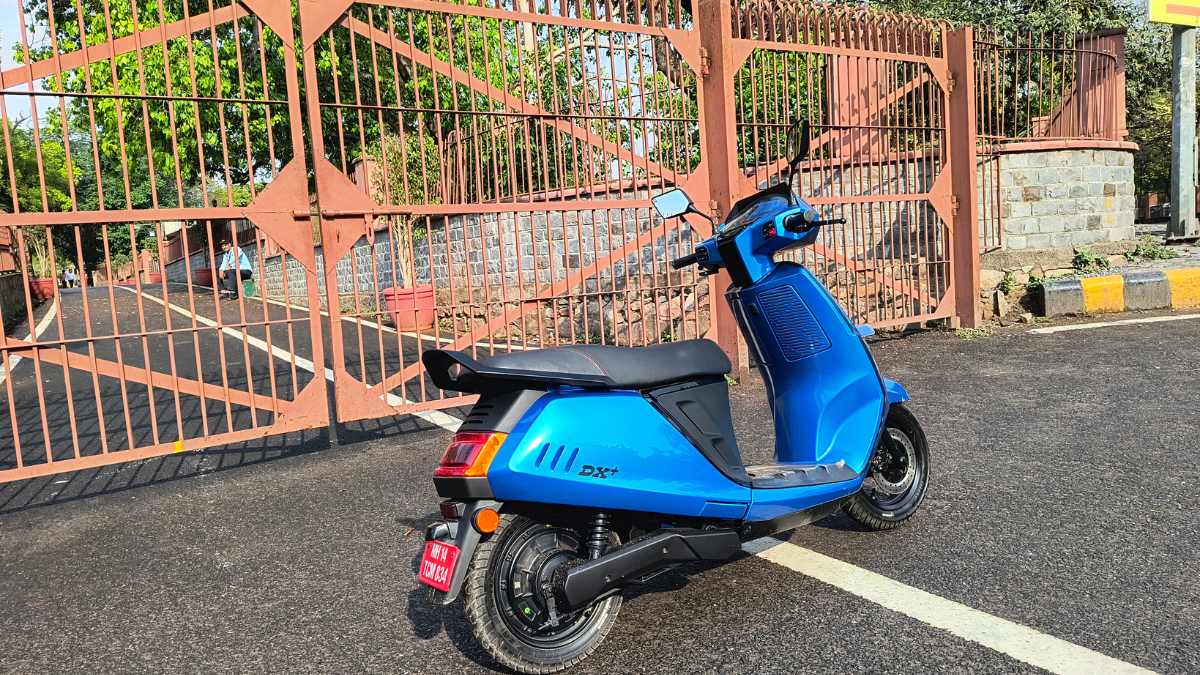
Three decades ago, the Kinetic Honda didn't just move people. It moved an entire market. While a generation traded their fathers' Bajaj Chetaks for the push-button start and automatic gears of the Kinetic Honda, a quiet revolution unfolded on Indian roads. Now, without Honda and without petrol, Kinetic is betting that the same spirit of innovation can succeed on electric power alone.
We tested the DX+ in Delhi traffic to see whether nostalgia, combined with market-driven engineering, can produce a scooter worth buying.
Design: Homage, Not Replica
The Kinetic DX+ doesn't copy the original. It references it. The silhouette remains recognisable. The three vertical vents at the rear, the gills under the seat, and the amber turn signals all nod to the classic design. But unlike the mostly plastic EVs flooding the market, the DX+ is built primarily with steel. It feels substantial.
The differences are equally deliberate. The DX+ is larger and sleeker. A K-shaped daytime running lamp adds a modern touch. The original's rear-mounted spare wheel is gone entirely. Analogue instruments have been replaced by an 8.8-inch digital display, and the scooter starts with a numeric passcode rather than a key.
Riding the DX+ in Real Traffic
The upright seating position is comfortable for two adults. Four riding modes are available: Range, Power, Turbo, and Reverse. In Range mode, which limits top speed to 50 km/h, our test unit delivered 88 km. It works well in traffic but lacks the acceleration needed for quick overtakes. Turbo mode delivers speed, but range dropped to 68 km.
Power mode is the practical choice. It provides the electric acceleration you expect from an EV, with a tested range of 80 km. On straight roads, the DX+ rides beautifully. However, it lacks the sharp agility of competitors like the Ather 450X. Sudden pothole dodges feel slightly jittery.
As a family EV, though, the DX+ comes close to ideal. The seat is wide and well-padded. Under-seat storage accommodated two helmets during our test. Hill hold is a genuinely useful feature when stopping on flyovers or basement ramps. Perhaps the most practical feature is the onboard charger. A retractable charging cable is built into the scooter, meaning you simply plug it into any 15A socket. No carrying cables. No relying on dedicated charging infrastructure.
Pricing and Variants
The DX+ variant we tested is priced at Rs 1,17,499, with an EMI option of Rs 2,789. The base DX variant costs Rs 1,11,499, with an EMI of Rs 2,475. However, the DX is hard to recommend. The DX+ includes the onboard charger and Telekinetic connected features: Find My Kinetic, Track My Kinetic, Guide Me Home, Geo Fencing Alert, and Data Analytics. Both variants share a 2.6-kWh battery, but claimed ranges differ slightly at 105 km for the DX+ and 102 km for the DX under standard test conditions.
The Competitive Landscape
The electric scooter market is proving what open competition does best: it gives consumers options. Each competitor has carved a distinct advantage.
- Ather Rizta: Two variants, S at Rs 1,05,157 and Z at Rs 1,23,156. Superior software integration with Google Maps and WhatsApp on screen.
- Bajaj Chetak: Five variants from Rs 89,500 to Rs 1,02,500. The Chetak competes on choice itself, offering modern European styling across a wider price range.
- TVS iQube: Four variants with battery options from 2.2 kWh to 5.3 kWh, ranges from 94 km to 212 km, priced Rs 1,10,785 to Rs 1,71,879. TVS leverages its far larger dealership and service network. Also available under a Battery as a Service model that reduces the upfront cost by roughly Rs 40,000, though riders pay per kilometre to the financier.
- Hero Vida VX2: Three variants from Rs 87,740 to Rs 1,12,490. Its standout advantage is a removable battery that can be carried indoors for charging, removing the need for a dedicated charging point. Also available under BaaS.
The Verdict
The Kinetic DX+ proves that legacy brands can reinvent themselves without government subsidies or protectionist policies. The market is deciding what works. Onboard charging eliminates the infrastructure anxiety that plagues many EV buyers. Steel construction signals durability. Connected features add genuine value rather than gimmickry.
The DX+ isn't the sharpest handler in traffic, and its range won't set records. But as a practical, well-built family scooter that refuses to rely on public charging networks, it makes a compelling case. Kinetic didn't need a mandate to build this. Consumer demand, and the memory of what the brand once meant, was enough.