
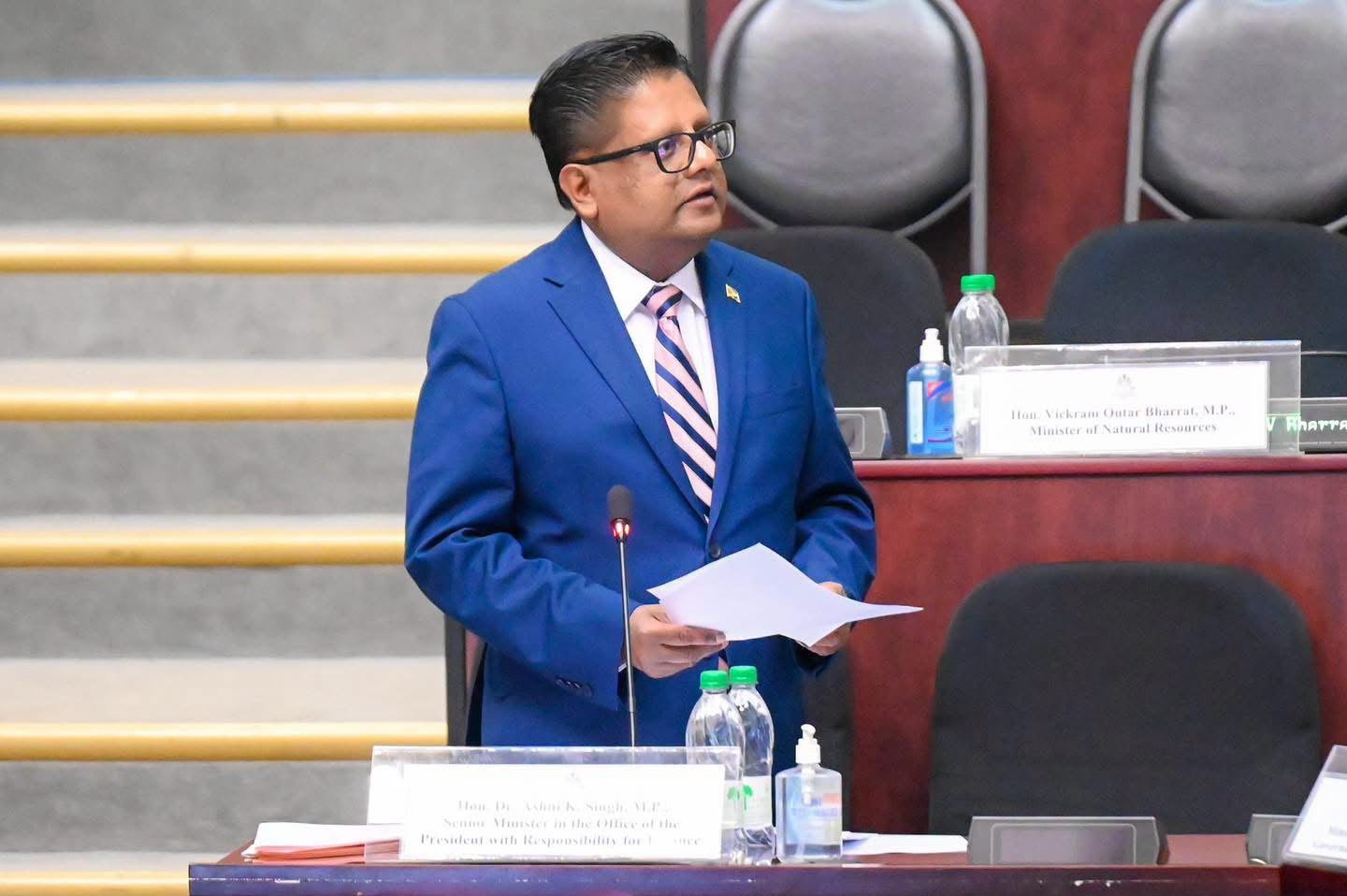
Guyana's National Assembly debated late into Wednesday night and early Thursday over a bill that would remove spending caps on lifetime benefits for former presidents, with opposition MPs calling the package an uncapped burden on taxpayers while government MPs said it restores dignity to the highest office.
The Former Presidents (Benefits and Other Facilities) Bill 2026, piloted by Senior Minister with responsibility for Finance Dr. Ashni Singh, would repeal the 2015 amendments passed under the APNU+AFC administration and restore the framework of the 2009 Act introduced by the then PPP government, according to Kaieteur News.
What the bill would restore
The legislation provides former presidents with paid water, electricity and telephone bills at their residences, household staff, clerical and technical assistance, medical treatment for themselves and dependent family members, personal security, state-owned and maintained vehicles, toll-free road transportation and an annual vacation allowance equal to two first-class return airfares.
It also restores tax exemptions equivalent to those enjoyed by a sitting president. And it removes the clause under which a former president loses entitlements if he or she engages in business, trade or paid employment, or is convicted of a criminal offence.
Dr. Singh told the House the 2015 law was never about cost. “The 2015 Act was not about prudent or cost or about money, the 2015 Act was about political vindictiveness and retribution,” he said.
He said the restrictions were aimed at former PPP presidents Bharrat Jagdeo, Samuel Hinds and Donald Ramotar, but a court ruled the law could not be applied retroactively, leaving their benefits untouched. The first former president caught by the 2015 Act was David Granger, who had assented to it while in office.
“The law it wrote could not reach its intended targets and would instead fall first and foremost prospectively upon its own author when he in turn became a former president,” Dr. Singh said.
The minister noted that only seven people have retired as former presidents since Guyana became a republic. “We are not legislating for a huge crowd,” he said.
Opposition: no ceiling, no case
Opposition MP Kuice Sharma Solomon said he supports dignity for former presidents as much as for anyone who has served the country, but drew a line at benefits without a financial ceiling.
“One can dress it up in the finest constitutional language...one can speak of the honor of the presidency, the dignity of the office and importance of recognising service but when a person already receives a substantial lifetime of pension and then seeks excessive and move excessive on that package of publicly funded facilities with no clear define limit for staff, security and expenditure, we must be honest about what we are looking at...this is pure greed,” Solomon said.
Opposition MP Gobin Harbhajan argued that retirement benefits should not be set by the office a person held. “The dignity of office is not sufficient reason to propose huge, unreasonable benefit, to those who serve as president, what must be considered is the difference between the benefit granted to the retired president and the minimum wage,” he said.
He asked how the government could justify uncapped benefits while public servants, nurses, teachers and members of the Joint Services wait on salary increases. “The proposal reflect the policy of making the rich richer and making the poor poorer. Is this not violating the principle of fairness,” he asked.
Opposition MP Dawn Hastings-Williams said the bill asks Guyanese “to underwrite a lifetime package of privileges at a time when too many families are struggling to afford food, water, electricity, transportation, medication and a decent home.”
MP Amanza Walton said the government's defence of the bill would not change its substance. “There is no way they can defend uncapped benefits and so what they will do is classical, they will line-up a group of speakers right...to talk about of the ills of the former APNU+AFC government,” she said.
She also noted that President Irfaan Ali is in his second and final term, so if the 2015 Act stands, his own benefits will be capped.
Government: security and medical care are state duties
Local Government Minister Priya Manickchand said she had hoped the debate would restore dignity to the office and align Guyana with practice in other Caribbean, Latin American and Western countries. She said the government had in fact never capped Granger's benefits under the 2015 Act.
Government MP Sanjeev Datadin called the 2015 amendments “humiliation dressed up as reform.”
“This is not a new idea, it is not a new package, it is a framework that this House has passed in 2009...it was right then, it was wrong in 2015 to repeal it and it is right today,” he said. Security and medical care for former presidents, he argued, are responsibilities of the state rather than perks.
Government MP James Bond said the opposition's position amounted to denying Granger dignity in retirement, and that the 2026 bill would put him on the same footing as Jagdeo, Hinds and Ramotar.
A regional question with a price tag
The argument is not unique to Georgetown. In Cyprus, lawmakers debated a bill to end lifetime perks for former leaders, with Akel MP Valentinos Fakontis arguing that allowances should support the institutional role of former presidents rather than personal gain, as Cyprus Mail reported. In Kenya, taxpayers face a bigger pension bill for MPs after the National Assembly voted a 2.5 percent increase, pending presidential assent, Daily Nation reported.
What separates Guyana's bill is the absence of any cap at all. Pensions and facilities for seven former presidents are a small line in a national budget, but the principle is not: once a benefit is written without a ceiling, every future officeholder inherits it, and every future government inherits the political cost of touching it.
The bill now returns to the House for the remaining stages of debate. If passed, the 2015 caps fall away and the 2009 framework returns in full, with no limit on staff, security or household expenditure.
Frequently asked questions
What does the Former Presidents Bill 2026 change?
It repeals the 2015 amendments that capped benefits for former presidents and restores the 2009 framework, including paid utilities, household staff, medical care, security, vehicles, a vacation allowance and tax exemptions matching a sitting president. It also removes the clause that strips benefits on conviction or paid employment.
How many former presidents would benefit?
Seven people have retired as former presidents since Guyana became a republic, according to Dr. Ashni Singh.
Why did the 2015 law not affect Jagdeo, Hinds and Ramotar?
A court ruled the 2015 Act could not be applied retroactively, so their benefits continued. David Granger, who assented to the law, was the first former president it could have touched.
Is there any spending limit in the 2026 bill?
No. Opposition MPs objected specifically to the absence of a financial ceiling on staff, security and household expenditure.