
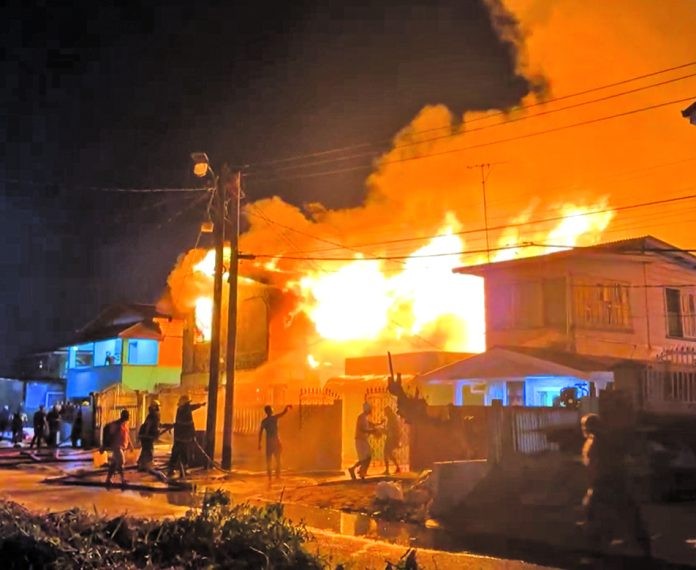
Fire incidents across Georgetown, the East Coast and East Bank of Demerara rose by 21.41 per cent between January and October 2026, driven overwhelmingly by grass and rubbish fires that the Guyana Fire Service says are preventable.
The Fire Service recorded 930 fires during the ten-month period, up from 766 for the same stretch of 2025, according to figures reported by INews Guyana. Divisional Officer Otis Charges, who heads Operations, said grass and rubbish fires alone jumped 39.88 per cent, from 341 incidents last year to 477 this year.
Grass and rubbish burning behind most of the surge
In some affected communities, roughly 90 per cent of reported fires are linked to grass and rubbish burning. The pattern is clearest along the East Coast and East Bank of Demerara, where grass fires remain a persistent challenge, while Georgetown has recorded a high number of rubbish fires. Grass and rubbish fires account for more than half of all incidents recorded in A-Division.
The Fire Service warned that fires lit to dispose of household waste or clear vegetation can spread quickly beyond their intended locations, especially in dry and windy conditions. Nearby homes, businesses, vehicles and electrical infrastructure are all at risk when a small burn gets out of hand.
The smoke itself is a hazard. The GFS flagged health concerns for people with respiratory conditions and safety risks for motorists driving through affected roadways.
A strain on firefighters and emergency response
Every unnecessary deployment carries a cost. Firefighters responding to grass and rubbish fires work in intense heat, shifting winds, thick smoke and, at times, hazardous materials.
The greater problem is what those deployments displace. The Service noted that repeated callouts to rubbish fires pull personnel, appliances and equipment away from other emergencies, including house fires and rescue operations where lives may be in immediate danger. A fire started to burn trash can become an emergency that threatens an entire community.
This is not confined to Demerara. Guyana Times reported on November 12 that Region Two (Pomeroon-Supenaam) saw a 41 per cent increase in fire calls, with grass, rubbish and agricultural waste fires accounting for about 81 per cent of all incidents there. Grass, rubbish and paddy-shell fires in that region rose 52.9 per cent.
Region Three (Essequibo Islands-West Demerara) shows the sharpest deterioration. According to the Guyana Chronicle, fire incidents in that region surged 189 per cent in October 2026 compared with the same month last year, and about 90 per cent of fires recorded there in October involved garbage, grass and bush. The department warned the trend places additional pressure on firefighting resources, which could affect its ability to respond to other emergencies across the division.
Three people have died in fires nationally between August and October, with several injuries and numerous persons left homeless, Guyana Times reported.
A question of individual responsibility
There is a temptation, when public numbers deteriorate this sharply, to reach for a new regulation, a new agency or a new enforcement programme. That would be the wrong reflex. The data the Fire Service itself has published points to something simpler: thousands of Guyanese are lighting fires to clear waste and vegetation, and the consequences are landing on their neighbours and on an overstretched fire brigade.
The GFS is appealing to residents to adopt safer methods of disposing of household waste and clearing vegetation, and to stop indiscriminate burning. It has also asked the public to report uncontrolled fires before they spread, and to call the emergency hotline 912 immediately when a fire breaks out.
The Service stressed that preventing fires requires greater public cooperation. That is the honest answer. A fire brigade cannot be stationed in every backyard, and no amount of state intervention substitutes for a householder choosing not to torch a pile of garbage beside a fence line on a dry, windy afternoon.
What happens next depends on whether that message lands. If burning habits do not change, the numbers for 2027 will be worse, and the next grass fire that diverts an appliance may be the one that delays a crew reaching a house fire where someone is trapped inside.