
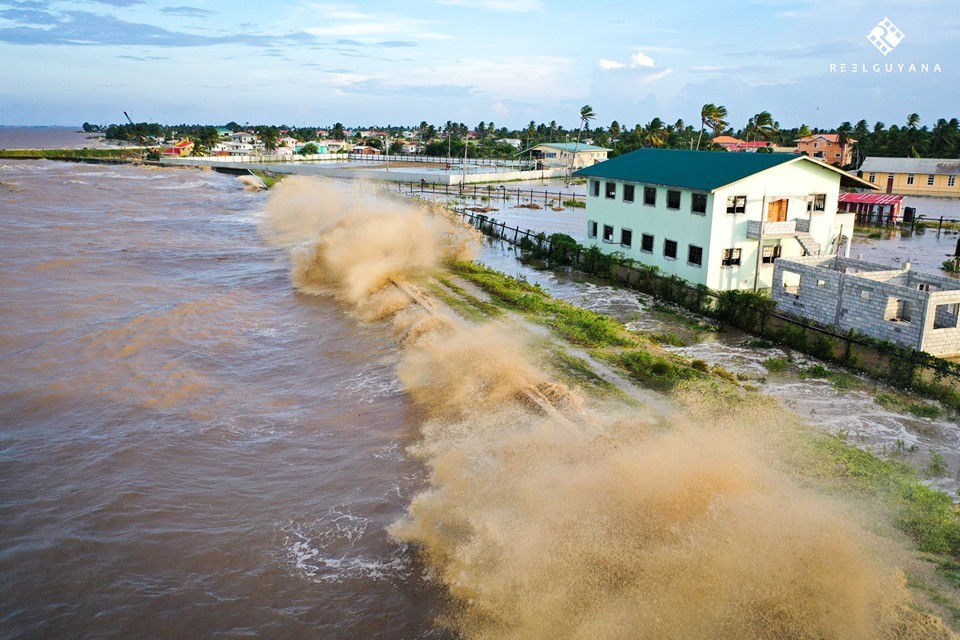
Guyana's oil-driven economic boom is concentrating an estimated US$43.5 billion in assets along a coast that sits below sea level, and the Commonwealth is now warning that the country's governance and financing arrangements are not yet strong enough to manage the threat.
The warning comes from a study published in October by the Commonwealth Secretariat's Climate Change and Oceans Directorate, which examined sea level rise in five member states: Guyana, Kiribati, Papua New Guinea, Tonga and Tuvalu. According to Kaieteur News, the study found that none of the five countries has adaptation governance or finance arrangements adequate to the scale of the danger.
What the Commonwealth study found
The study's central point for Guyana is stark. The Low Coastal Plain, home to roughly 90 per cent of the population and more than half of GDP, lies between 0.5 and 1 metre below sea level at high tide. Without proper adaptation strategies, the study warns, the coastal zone is likely to experience what it calls catastrophic flooding.
Sea levels around Guyana are rising faster than the global average. Worldwide the figure is roughly 3.2 to 3.5mm per year; in Guyana the study puts the range at 4.7 to 10.2mm per year. Tuvalu and Kiribati record about 5mm per year, while Tonga reaches 7.3mm.
The report identifies governance weakness as the most consistent constraint across all five countries. Legal frameworks, it says, are fragmented and resource-specific rather than integrated. Guyana in particular still lacks comprehensive coastal-zone management legislation and enforceable building codes.
“There has been a tendency toward maladaptation, including incompatible development in areas designed as reserves, destruction of mangrove ecosystems, poor solid waste management and habitation of 'bottom houses' in highly vulnerable zones,” the study states.
Why the US$43.5 billion figure is higher than earlier estimates
The number is dramatically larger than previous assessments. Earlier studies by ECLAC, the UN Economic Commission for Latin America and the Caribbean, placed exposed coastal assets at roughly US$5 billion. The difference, the Commonwealth notes, reflects in large part the growth of Guyana's GDP since the oil and gas industry took off.
“Guyana's oil-driven boom is concentrating still more assets on the coast, lifting estimated asset exposure to episodic flooding to around US$43.5 billion,” the study says.
The authors add a caution of their own. Applying an asset-to-GDP multiplier drawn from a rapidly changing, oil-driven economy, they write, may overstate the current value of assets exposed to coastal flooding. The estimate should therefore be read with care. The Rio Times also reported on the findings, noting that oil growth is pulling ever more assets toward the shoreline.
The NRF question: where the money goes
For a country that has built its fiscal future on petroleum, the study raises a question that goes to the heart of public finance. Guyana's offshore oil revenues flow through the Natural Resource Fund. Whether those resources are directed toward adaptation, the report says, depends entirely on national budget priorities.
“Resource rich members such as Guyana should explicitly earmark a share of national revenues for long-term coastal resilience,” the study recommends.
This is a point worth taking seriously, and not only as environmental policy. The oil economy is itself accelerating the exposure. The Commonwealth finds that oil and gas development is contributing to the concentration of people and onshore assets in the coastal zone, which increases flood risk. The very industry generating the wealth is deepening the liability that wealth must eventually cover.
Inland expansion: the opportunity Guyana has and the islands don't
The study's most consequential recommendation for Guyana is demographic. The country should reduce the number of people exposed to coastal hazards by developing population centres away from flood-prone areas.
“Guyana must take steps to reduce its vulnerability through a series of targeted measures, including inland expansion,” the report states.
Here Guyana holds an advantage the Pacific island states in the study do not. The vast hinterland offers a genuine pathway for population redistribution, something largely unavailable to small island developing states. Yet until now, the study observes, most development has remained pinned to the coast, continuing a pattern set long before oil arrived.
The priorities the Commonwealth sets out
The case study lists several priorities for action: redistributing population centres away from flood-prone areas, sustained investment in sea defences and drainage, protection and restoration of mangrove ecosystems, improved access to economic resources and insurance, protection of critical infrastructure, investment in research and data collection, improvement of environmental quality and public health, and strengthened disaster co-ordination and community organisation.
None of these requires new taxes or heavier state intervention in the economy. What they require is that existing oil revenues, already flowing into the public purse, be spent with discipline and directed toward protecting the productive base of the country rather than consumed in the short term. A government that fails to defend the coastline is not defending the economy; it is liquidating it slowly.
The study also frames the moment as an opportunity. Guyana's economic transformation through oil and gas, it says, presents a timely opening to incorporate adaptation strategies and safeguard future socio-economic gains. The window, however, is defined by geography and physics, not by political convenience.
Frequently asked questions
How much of Guyana's assets are at risk of flooding?
The Commonwealth study estimates exposure at around US$43.5 billion, up sharply from earlier ECLAC estimates of about US$5 billion, though the report cautions the newer figure may overstate current values.
Why is Guyana's coastal zone so vulnerable?
The Low Coastal Plain sits 0.5 to 1 metre below sea level at high tide, holds about 90 per cent of the population and produces over half of GDP, while sea levels there rise faster than the global average.
What does the Commonwealth recommend Guyana do?
The study recommends earmarking a share of national revenues for coastal resilience, expanding development inland, investing in sea defences and drainage, restoring mangroves and strengthening disaster co-ordination.