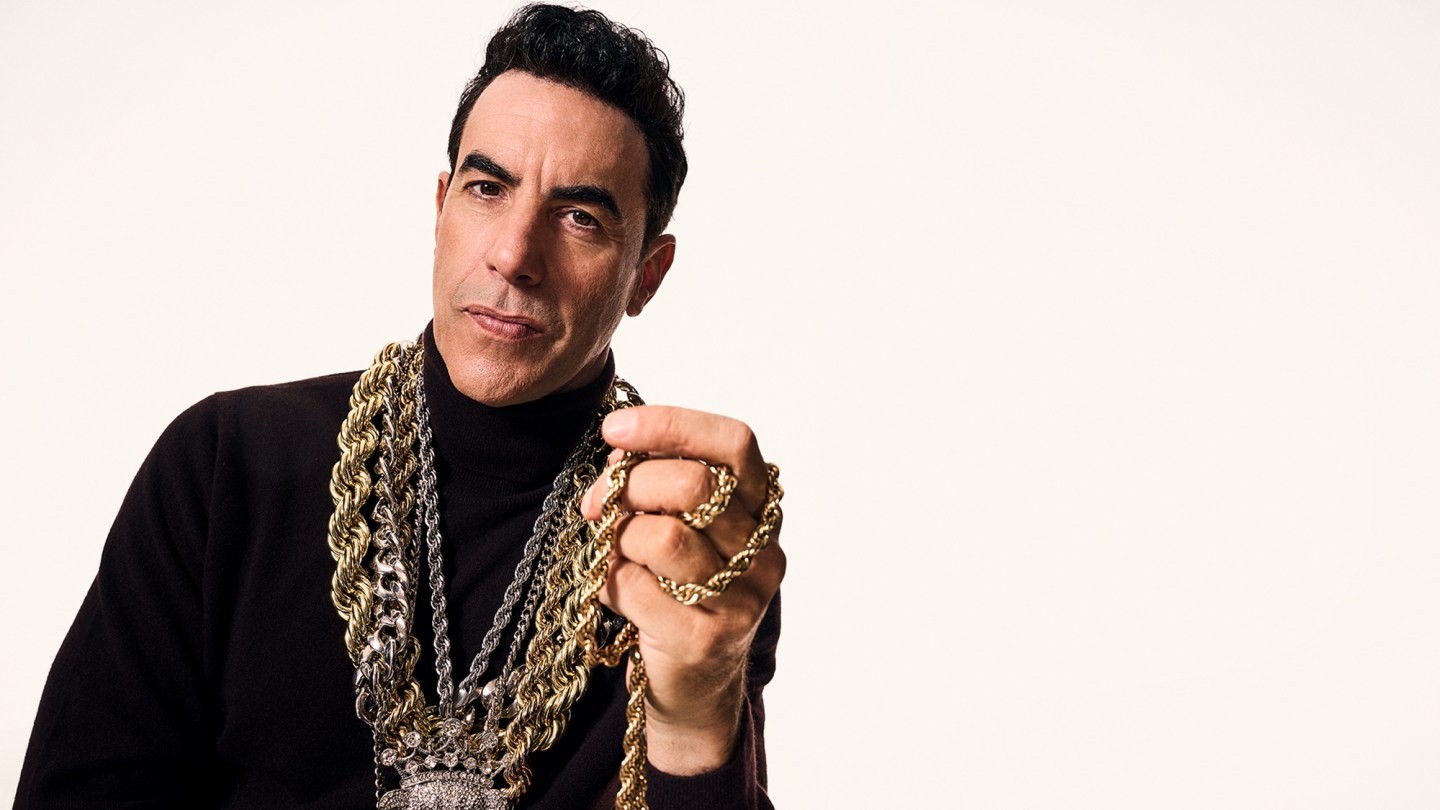
Sacha Baron Cohen's new film Ali G: Who Iz I? opens in theaters on October 23, 2026, arriving amid a boycott campaign, accusations of cultural appropriation and death threats that the comedian says now come from both the political left and the right.
In a long interview with The Hollywood Reporter, Baron Cohen insisted this will be his last guerrilla comedy, a promise he has made and broken before, most notably ahead of the 2020 Borat sequel that earned two Oscar nominations. His reason for returning, he said, is fear about where society is headed.
Why Baron Cohen resurrected Ali G
“Because I'm terrified of where our society is headed, and the way I can comment on that is through my comedy,” he told The Hollywood Reporter. “I wanted to show the extremism on both sides of the political spectrum and the danger of virtuous violence.”
The film reframes Ali G as a relic from another era, unaware that he is deeply problematic, and pits him against an ultraprogressive rival, also played by Baron Cohen, who tries to cancel him for cultural appropriation. The comedian described the result as a thriller in the mold of The Fugitive, and he plays a third character, a former Mossad agent. He called it “my version of the Avengers.”
The decision to revive the character precisely because he is outdated and problematic is a deliberate one, as Metro reported. Baron Cohen has defended the film at length against the stereotype accusations, arguing that “the joke is on him,” according to Yahoo!. The character, he maintains, is a white cultural appropriator who is funny because he is delusional, stealing slang from the Tupac Shakur records he admires rather than from the Afro-Caribbean community in west London.
A boycott campaign and a studio that held firm
A social media campaign to boycott the film took shape as soon as trailers appeared, with some in Baron Cohen's camp suggesting a coordinated push linked to his past support for Israel. Baron Cohen, who voiced support for Israel after the October 7 attacks but has stayed quiet on the Gaza war since, said the level of organization surprised him.
“I knew that this was going to happen. The level of organization is surprising, but this is a trend of Jews being portrayed in certain ways and trying to be silenced,” he said.
Amazon, which will stream the film on Prime Video after its theatrical run, has not flinched. Courtenay Valenti, head of film, streaming and theatrical at Amazon MGM Studios, said the studio wants to be in business with storytellers who have distinctive visions. “He has always been fearless in his comedy, with a unique ability to tap into the cultural conversation in ways that are both provocative and entertaining,” she said.
Colton Dunn, one of three Black writers hired for the film, said the appropriation claims were anticipated and addressed on screen. “At the heart of it, Sacha and the movie want to defeat evil and hate. That's the intention behind it,” Dunn said.
The $3 million scene and the price of creative control
The film's logistics were as punishing as its publicity. The final scene is an eight-hour continuous shot across 12 desert locations, featuring gunfire, explosions, drones and a medical procedure. Several crew members, including a bodyguard, were treated in hospital for dehydration. Baron Cohen drank 11 liters of Pedialyte under the watch of an endurance specialist who works with Tour de France cyclists.
When a wildfire forced the evacuation of one location mid-shoot, the production shut down. Insurance covered $1 million of a $4 million day, and Baron Cohen personally absorbed the remaining $3 million. “Obviously it was my money, which is a very stupid idea,” he said.
He also holds final cut as producer and director, a rarity in a business built on studio control. His method is obsessive: he attends every screening, records audience laughter and grades jokes frame by frame. “If something is funny, then I will go to war for it,” he said. “My allegiance is to the audience.”
That independence has consequences. Longtime collaborator Anthony Hines told The Hollywood Reporter the marketing stunts were giving Amazon “panic attacks on the daily,” including a London Marathon stunt with 300 Ali G look-alikes that the studio shut down. Baron Cohen, ever the free agent, found the funny side: some fans were doing better Ali G impressions than he was.
Is Ali G past his sell-by date?
The question hangs over the release, and the BBC has asked it directly. Baron Cohen's answer is that the character's datedness is the point: a fossil from a more innocent era of satire, dropped into a culture where outrage is an industry and where, as he puts it, people can no longer distinguish facts from lies.
“If we don't have these shared facts, then democracies crumble and we can't have a tolerant society,” he said. He co-founded Stop Hate for Profit with the NAACP, Color of Change and the Anti-Defamation League to push social media platforms on misinformation, so he comes to that argument with receipts.
Next up is a West End debut in a Quentin Tarantino play, with nine hours of sword-fighting training a week, a collaboration Baron Cohen says the director has promised will be genuine. After that, he swears, no more Borat, no more Bruno, no more Ali G. He is aware nobody believes him.
FAQ
When does Ali G: Who Iz I? reach theaters?
The film opens in theaters on October 23, 2026, and streams on Amazon Prime Video shortly afterward.
Why is the film facing a boycott?
Critics accuse the Ali G character of enforcing racial stereotypes and cultural appropriation. Baron Cohen says the character is a delusional white appropriator and that much of the online campaign is orchestrated rather than organic.
Did Baron Cohen fund the film himself?
He personally covered a $3 million loss when a wildfire disrupted the film's climactic eight-hour continuous shot, which was insured for only $1 million of a $4 million day.