
Nigerian public hospitals are turning patients away and delaying life-saving treatment because the country has far too few medical specialists to handle a fast-growing burden of chronic disease, according to an investigation published by Punch Newspapers on October 18, 2026.
Patients described being turned away at registration, waiting eight hours to see a doctor, and spending their savings on repeat visits without ever meeting a consultant. The shortage, driven by mass emigration of doctors, poor pay and inadequate facilities, has left Nigeria with roughly 40,000 licensed doctors for a population of more than 220 million.
Patients queue from dawn, and many are sent home
At the Federal Medical Centre in Abeokuta, Ogun State, a patient who gave his name only as Ademola said he was told the hospital had capped the day's list at about 70 patients when he arrived at 8am.
“I was here about three weeks ago. I got to the hospital around 8am, but I was surprised when they told me that the number of patients to be attended to had been selected,” he told Punch.
He returned shortly after 7am the next day, registered, and still did not see a doctor until about 3pm. Another patient, Mrs Adelaja, said she had waited from 7am until nearly midday without even completing registration.
In Gombe, in the country's North-East, Maryam Ahmed said her brother's eye condition worsened after they were unable to see a specialist, and the family could not afford private care. In Lafia, Nasarawa State, a patient named Ibrahim said he spent more than N80,000 over three weeks at the Federal University Teaching Hospital without seeing a consultant, because the senior doctor he needed lived outside the city and only visited occasionally.
Those stories carry a warning for any country that relies on a state-run health system while failing to create conditions that keep trained professionals at home. When doctors leave because pay, equipment and working conditions are intolerable, no amount of official planning can conjure them back. The market for medical talent is global, and Nigerian specialists know exactly what their skills are worth elsewhere.
Chronic diseases now outweigh malaria, but specialists are vanishing
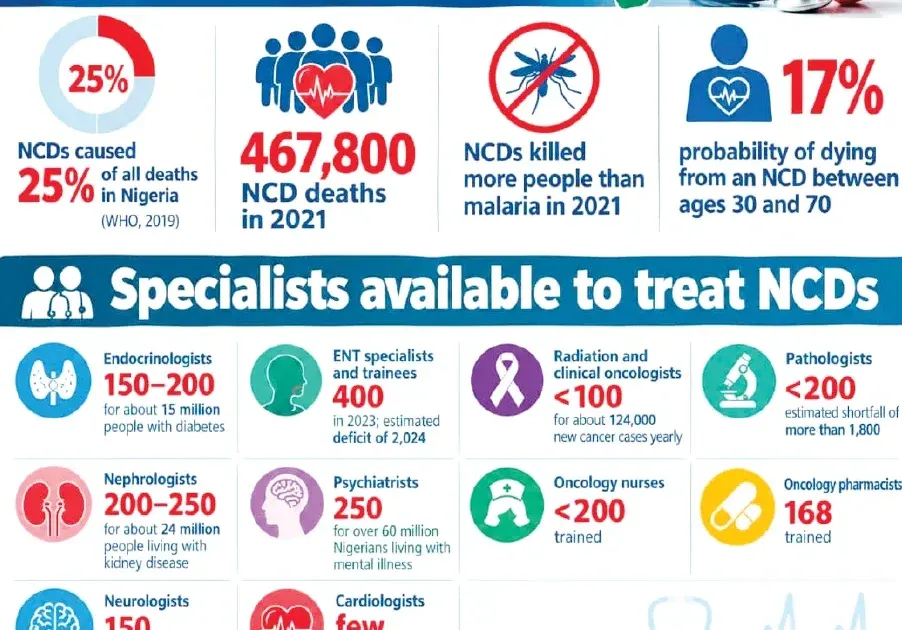
The human cost is measurable. In 2021, non-communicable diseases caused an estimated 467,800 deaths in Nigeria, roughly 2.4 times the 194,000 deaths attributed to malaria that year, according to figures cited by Punch from the World Health Organisation's data portal. Globally, NCDs such as cardiovascular disease, cancer, diabetes and chronic respiratory illness account for nearly three-quarters of deaths, and 86% of the 17 million premature NCD deaths each year occur in low- and middle-income countries.
Yet the specialist workforce is a fraction of what the numbers demand. Prof. Andrew Uloko, president of the Endocrine and Metabolism Society of Nigeria, said the country has only 150 to 200 practising endocrinologists for about 15 million Nigerians living with diabetes. Specialists are concentrated in major cities, and even urban centres fall short.
“Workload is stupendously heavy. You practically do not even have time for yourself,” Uloko said, adding that endocrinologists continue to emigrate in search of better pay, better welfare and the diagnostic infrastructure their specialty requires.
The numbers are similarly dire elsewhere. Prof. Ejiofor Ugwu, national president of the Diabetes Association of Nigeria, said Nigeria needs at least 2,400 endocrinologists to meet the international benchmark of one per 100,000 people. Each Nigerian endocrinologist currently serves about 1.6 million people, against one per 70,000 in the United Kingdom and one per 35,000 to 40,000 in the United States.
Ugwu said a typical clinic day at his teaching hospital brings 80 to 120 patients for just two consultant endocrinologists, when a proper workload would be no more than 10 patients per specialist per day.
From oncology to anaesthesia, the gaps compound
The Punch investigation tallied shortages across nearly every specialty. Nigeria records about 124,000 new cancer cases and more than 80,000 cancer deaths annually, yet the Association of Radiation and Clinical Oncologists in Nigeria counts fewer than 100 radiation and clinical oncologists. The country has fewer than 200 trained pathologists, a shortfall of well over 1,800 against the African Society for Laboratory Medicine's benchmark, and of 400 oncology nurses trained and licensed as of November 2025, fewer than 200 are still practising, with the rest having emigrated.
There are between 200 and 250 nephrologists for an estimated 24 million Nigerians living with chronic kidney disease, roughly one kidney specialist for every 96,000 to 120,000 affected people. About 150 neurologists serve more than 240 million Nigerians, with some states having few or none. There are 250 psychiatrists for over 60 million people living with mental illness, and some northern states have no resident cardiologist at all, leaving patients dependent on visiting specialists.
Prof. Aliyu Kodiya, president of the Otorhinolaryngological Society of Nigeria, said Nigeria's roughly 400 ear, nose and throat specialists and trainees face a deficit of 2,024 against the workforce benchmark. At the current annual output of about 12 new specialists, closing that gap would take 169 years, assuming nobody retires or leaves.
“The ratio is 1:606,000 population density benchmark instead of 1:100,000,” Kodiya said, warning that delayed diagnosis of conditions such as childhood hearing impairment and head and neck cancers carries serious consequences.
Fixing it means making practice worth staying for
Every specialist association Punch spoke to reached the same conclusion: doctors are not leaving Nigeria because they lack patriotism. They are leaving because the system offers them neither decent remuneration nor the tools to do their work. Prof. Alhassan Mohammed, president of the Nigerian Society of Anaesthetists, said better pay and improved welfare could retain specialists and encourage some who have emigrated to return.
The former Nigerian Medical Association president, Prof. Mike Ogirima, put it bluntly, calling Nigeria's doctor-to-patient ratio of roughly one to 8,000 “horrible” against the WHO recommendation of one to 600. Nigeria produces only about 3,000 doctors a year.
“If we are producing just 3,000 doctors yearly, it will take at least 10 years to catch up, and that is assuming no doctor leaves the system. We cannot afford to wait that long. That is why doctors are overworked, exhausted, and burned out,” he said.
The editorial lesson for Guyana and other small economies watching their own doctors depart is straightforward. Retention follows conditions: competitive pay, functioning equipment, reliable diagnostics and a working environment that treats professionals as assets rather than costs. Health Minister Muhammad Pate admitted on October 15 that NCDs had become “an increasingly faster-growing segment of our burden of disease.” Whether his government responds with the investment and reform that specialists are asking for, or with more of the same underfunded state apparatus, will decide how many more Nigerians queue at dawn only to be sent home.
Frequently asked questions
How many doctors does Nigeria have?
Nigeria has about 40,000 licensed doctors for a population of over 220 million, far below the estimated 300,000 needed, according to figures cited by Punch Newspapers.
Why are Nigerian specialists emigrating?
Specialists cited poor remuneration, unfavourable working conditions, inadequate diagnostic infrastructure and better professional opportunities abroad as their reasons for leaving.
How severe is Nigeria's endocrinologist shortage?
Nigeria has between 120 and 200 endocrinologists for about 15 million people with diabetes, meaning each specialist serves roughly 1.6 million people.