
Guyana trained teachers reach 98% after CPCE graduation
Guyana’s trained teacher share hit 98% after 1,959 CPCE graduates entered the workforce, as spending and retention come into focus.
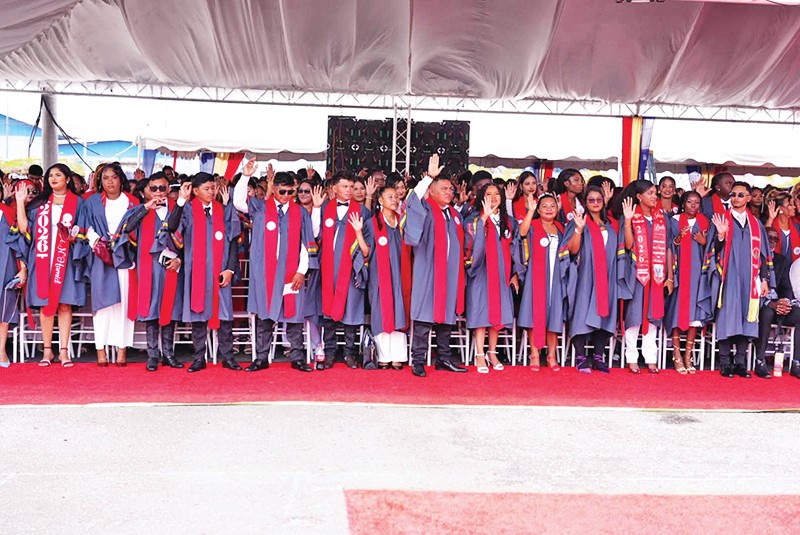
Guyana’s share of trained teachers reached 98 per cent on Friday as 1,959 teachers graduated from the Cyril Potter College of Education, Education Minister Sonia Parag announced.
The ceremony at the National Stadium in Providence, East Bank Demerara, added a record cohort to the public education system. According to Guyana Times, the class comprised 1,700 women and 259 men, renewing questions about both classroom capacity and the low number of men entering teaching.
A record CPCE graduating class
The 2026 cohort was 614 graduates larger than the 1,345 teachers who completed their training in November 2025, an increase of about 46 per cent. INews Guyana reported that the ceremony was CPCE’s 93rd graduation exercise.
Graduates qualified in nursery, primary and secondary academic education, as well as Technical and Vocational Education and Training. Their numbers included 351 nursery teachers, 461 primary teachers, 254 secondary academic teachers and 410 TVET teachers.
Other graduates specialised in agriculture, languages, science, mathematics and the arts. Training also covered Health and Family Life Education, Literacy Studies, Guidance and Counselling, and Special Needs Education, with 239, 59 and 109 graduates respectively in the first three fields.
Music education recorded a smaller but notable increase. Seven music teachers graduated this year, compared with one in the previous cohort.
How Guyana reached 98 per cent trained teachers
Parag told graduates that Cabinet first discussed the goal of a fully trained teaching workforce in 2020, when approximately 68 per cent of teachers were trained. She said 8,042 people have since qualified through CPCE across seven graduating cohorts from 2020 to 2026.
Of that total, 6,688 completed their training during the five years from 2022 to 2026. The minister said hinterland communities had also seen a marked change, with their share of trained teachers rising from 43 per cent in 2020 to approximately 95 per cent.
The expansion of CPCE programmes and satellite centres has made training available across all 10 administrative regions. That matters in a country where distance can impose costs on students and workers well beyond tuition, particularly for people living far from the main urban centres.
Parag said 1,331 trainees had already registered to begin training this year through 20 satellite centres. Some new entrants, she added, had been encouraged by the achievements of Friday’s graduating class.
The minister acknowledged that attracting more men remains unfinished business. With women accounting for nearly 87 per cent of the latest cohort, male participation is now one of the clearest gaps in the government’s recruitment figures.
Spending, access and public accountability
Parag placed the graduation within a broader programme of state spending. She said $85 billion was spent during the first half of 2026 from the $183 billion allocated to education for the year.
That expenditure covers school rehabilitation, safe learning environments, teacher training and other initiatives. Measures cited by the minister include transportation grants for students, financial support for candidates to sit up to eight Caribbean Secondary Education Certificate subjects, and the write-off of University of Guyana student loans for eligible borrowers who obtained loans before 2025.
The government says these policies reduce costs for families and widen access. They do remove immediate financial barriers, but they also commit substantial public funds. Taxpayers therefore need more than input totals to judge whether the investment is working.
Graduation figures show how many teachers have been trained. They do not, by themselves, show whether schools retain those teachers, whether attendance improves or whether pupils learn more. Publishing retention rates, regional staffing figures and learning outcomes alongside annual spending would give the public a clearer basis for assessing value for money.
The same test applies to CPCE’s expansion. Satellite centres can widen access without requiring every trainee to relocate, but their worth will ultimately be measured by completion rates, classroom performance and the number of graduates who remain in the profession.
Graduates urged to protect their wellbeing
The ceremony recognised valedictorian Lashauna Peters, a 21-year-old graduate from Berbice. She urged her classmates to remain disciplined and committed to their responsibilities while maintaining a balance between work and personal life.
Peters warned against allowing career ambitions to crowd out personal wellbeing and mental health. She stressed the importance of seeking help when necessary and called on teachers to support one another, describing teaching as a community in which educators should help each other succeed.
Parag also emphasised the need for guidance counsellors, saying their services were required more than ever. The specialised programmes are intended to help teachers respond to pupils’ academic, social, emotional and developmental needs and support more inclusive classrooms.
The Ministry of Education announced that graduates appointed as Grade One Masters and Mistresses would have their appointments take effect from October 1, 2026.
CPCE leadership and the next intake
CPCE Principal Noella Joseph received a plaque recognising nearly 30 years of service to the institution, and her retirement was announced at the ceremony. Tributes were also paid to former educators, pioneers, lecturers, tutors, administrators and support staff involved in teacher education.
Guyana Chronicle reported that the graduation moved Guyana closer to a fully trained teaching workforce. The remaining challenge is not simply to close the final two-percentage-point gap. It is to sustain training, retain qualified staff and demonstrate that higher public spending produces stronger results for pupils.
Frequently asked questions
How many teachers graduated from CPCE in 2026?
A total of 1,959 teachers graduated on Friday, including 1,700 women and 259 men. The cohort was 614 larger than the November 2025 class.
What share of Guyana’s teachers are now trained?
Education Minister Sonia Parag said trained teachers now account for 98 per cent of the national workforce, compared with approximately 68 per cent in 2020.
How many new CPCE trainees have registered?
Parag said 1,331 trainees had registered to begin training through 20 satellite centres across Guyana.